Client and candidate expectations continue to rise, and recruitment agencies are under increasing pressure to deliver a consistently strong experience at every stage of the hiring journey.
Many recruitment agencies use Net Promoter Score (NPS) to better understand candidate and client loyalty, identify service gaps, and improve long-term relationships.
In this guide, we explain what NPS means in recruitment, how to calculate it, what a good score looks like, and how it compares with CSAT. We’ll also cover when recruitment agencies should send surveys and how to improve scores over time.
Author: Kim De-Ath | Last Updated: 5th June 2026.
What is Net Promoter Score (NPS) in recruitment?
Net Promoter Score (NPS) is a customer loyalty metric that measures how likely someone is to recommend your recruitment agency to others. The methodology was originally developed by Bain & Company and is now widely used across customer experience programmes to measure loyalty and advocacy.
The standard NPS question is: “How likely are you to recommend our recruitment agency to a colleague or friend?”
Respondents answer on a scale from 0 to 10. Based on their response, they are grouped into three categories:
-
Promoters (9–10): Loyal advocates likely to recommend your agency
-
Passives (7–8): Generally satisfied but less enthusiastic
-
Detractors (0–6): Unhappy respondents who are less likely to work with or recommend your agency.
For recruitment agencies, NPS provides a simple way to understand relationship health and long-term customer loyalty.
Why NPS matters for recruitment agencies
Recruitment is a relationship-driven industry. A poor candidate or client experience can quickly affect referrals, repeat business, and employer brand reputation.
Tracking NPS helps recruitment agencies:
-
Identify service issues early
-
Improve candidate and client experience
-
Increase referrals and repeat placements
-
Benchmark consultant performance
-
Reduce client churn
-
Strengthen long-term relationships
Unlike one-off satisfaction surveys, NPS focuses on advocacy and loyalty. Two major indicators of future growth.
How do you calculate NPS for a recruitment agency?
The NPS formula is simple and was designed to measure the percentage of loyal supporters compared to unhappy customers.
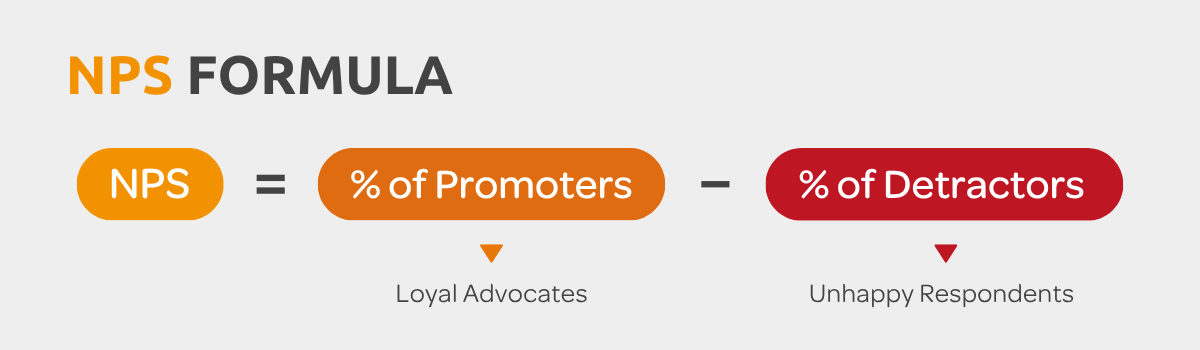
Step 1 > Calculate Percentages
% Promoters = Divide the number of promoters by the total number of respondents and multiply by 100.
% Detractors = Divide the number of detractors by the total number of respondents and multiply by 100.
Step 2 > Apply Formula
For example > 60% Promoters minus 15% Detractors = 45 Net Promoter Score
NPS scores range from -100 to +100. You can find a detailed breakdown of the methodology in Bain’s official NPS calculation guide.
What is a good NPS score for recruitment agencies?
There is no universal recruitment agency NPS benchmark because expectations vary between sectors, locations, and specialisms. However, as a general guide:
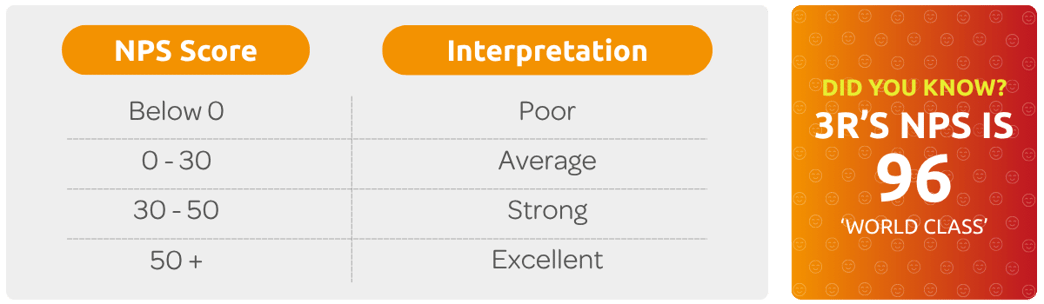
In many industries, scores above 30 are considered strong, while scores above 50 are viewed as excellent and above 70 as Exceptional. The most important factor for recruitment agencies is consistency and improvement, rather than chasing a single industry benchmark.
CSAT vs NPS in recruitment
Recruitment agencies often compare CSAT and NPS, but the two metrics serve different purposes.
|
What is CSAT? |
What is NPS? |
|
Customer Satisfaction Score (CSAT) measures satisfaction with a specific interaction or process. A common CSAT question might be: “How satisfied were you with the recruitment process?” CSAT is useful for measuring: Interview experiences, Placement processes, Consultant interactions and Support responsiveness
|
NPS measures long-term loyalty and advocacy. Instead of asking whether someone was satisfied with one interaction, NPS asks whether they would recommend your recruitment agency overall. Many organisations use NPS as a strategic relationship metric alongside operational satisfaction metrics such as CSAT.
|
Should recruitment agencies use NPS or CSAT?
The strongest recruitment customer experience strategies use both. NPS provides a broader view of loyalty and long-term relationship health, while CSAT helps agencies identify operational issues in specific parts of the recruitment journey.
For example: Use CSAT after interviews or placements. Use NPS quarterly or after major milestones.
Together, these metrics provide a more complete picture of customer happiness in recruitment.

What does a low NPS score mean for a recruitment agency?
A low NPS score usually points to underlying experience or communication issues. Common causes include:
-
Poor communication
-
Delayed feedback
-
Weak candidate matching
-
Lack of transparency
-
Slow hiring processes
-
Inconsistent consultant experience
Detractor feedback is often the most valuable because it highlights friction points in the recruitment process.
How can recruitment agencies improve their NPS score?
Improving recruitment NPS starts with acting on feedback consistently.
Improve communication >> Candidates and clients value clear, timely, and transparent communication.
Reduce delays >> Slow hiring processes are one of the biggest frustrations in recruitment.
Personalise the experience >> Tailored communication and stronger role matching improve engagement significantly.
Invest in consultant training >> A consistent consultant experience has a direct impact on loyalty and referrals.
Close the feedback loop >> Following up with detractors demonstrates accountability and helps rebuild trust.
Final thoughts
Net Promoter Score gives recruitment agencies a simple but effective way to measure loyalty, improve relationships, and identify service gaps across the recruitment journey.
Used correctly, NPS can help agencies; improve candidate and client experience, increase referrals and repeat business, benchmark service quality and support continuous improvement. However, NPS should not be used in isolation.
While NPS is valuable for measuring long-term loyalty and advocacy, it works best alongside other recruitment performance and customer satisfaction metrics such as CSAT, time-to-fill, repeat business rate, and client retention.
Recruitment agencies that combine quantitative metrics with qualitative feedback gain a much clearer understanding of customer experience and are better positioned to make meaningful service improvements.
For a broader look at recruitment customer experience metrics, read our guide on How to Measure Customer Satisfaction in Recruitment.
For recruitment agencies focused on sustainable growth, measuring customer sentiment is no longer optional — it’s essential.